

In the high-stakes world of Dubai real estate, the most expensive mistake you can make isn’t choosing the wrong marble; it’s failing to secure the right paperwork before the first hammer swings. We recognize that the prospect of navigating multiple government portals often feels overwhelming. Whether you’re upgrading a coastal villa or a high-rise apartment, the fear of heavy fines and project-halting stop-work orders is a heavy burden for any property owner to carry. Securing the necessary authority approvals for renovation Dubai is not merely a bureaucratic hurdle. It’s a vital quality assurance process that protects your property’s long-term value and structural integrity.
This guide serves as your definitive roadmap to mastering the complex landscape of permits and No Objection Certificates (NOCs) for 2026. We’ve simplified the technical requirements to help you move forward with quiet confidence and clarity. You’ll discover a clear breakdown of the jurisdictions governing your specific property, a realistic timeline for each stage of the process, and a checklist to ensure your vision remains compliant, safe, and seamless. By the end of this article, you’ll understand how a professional partnership can transform a daunting administrative task into a structured path toward your dream home.
Key Takeaways
- Understand why formal permits are essential for structural safety and the legal protection of your investment within the 2026 regulatory framework.
- Identify whether your specific community falls under the jurisdiction of Dubai Municipality, DDA, or Trakhees to secure the correct authority approvals for renovation Dubai.
- Learn the critical differences between minor aesthetic upgrades and major structural modifications to ensure you apply for the appropriate permit type.
- Master the chronological steps required to obtain a final completion certificate without facing unexpected administrative delays or technical friction.
- Explore the benefits of a turnkey approach where technical drawings and NOC submissions are managed by experienced specialists to ensure a seamless project lifecycle.
Understanding the Importance of Authority Approvals in Dubai
In the context of Dubai’s sophisticated real estate market, authority approvals for renovation Dubai represent a series of mandatory No Objection Certificates (NOCs) and building permits. These documents aren’t mere formalities. They are the legal backbone of any legitimate construction activity. Dubai maintains rigorous building codes to protect the structural integrity of its skyline and the safety of every resident. When you bypass these protocols, you compromise more than just a timeline; you risk the physical and legal security of your environment.
“Silent” renovations often lead to severe repercussions. Authorities can impose significant fines in AED, and in many cases, owners are legally compelled to restore the property to its original state at their own expense. This restoration process is often more costly than the initial work. Beyond avoiding penalties, securing official permits significantly enhances your property’s market value. A fully documented renovation provides future buyers with the assurance that all work, from MEP installations to structural changes, meets the highest standards of craftsmanship. It makes the property far more attractive during the resale process.
The Legal Framework: Dubai Building Code 2026
The Dubai Building Code 2026 provides a unified set of standards that govern every aspect of construction across the Emirate. This framework ensures consistency in fire safety, structural stability, and accessibility. It mandates specific material selections and technical specifications that only a registered contractor can certify. Compliance with this code isn’t just about following rules; it’s about adhering to a philosophy of quality that defines Dubai’s global standing. It ensures that every modification, no matter how small, contributes to the overall safety of the building.
Why DIY Approvals are Risky for Homeowners
Attempting to manage the approval process independently is often a path to frustration. The technical requirements involve complex architectural drawings, detailed floor plans, and precise MEP layouts that must be submitted through specialized digital portals. Most authorities require a trade-licensed contractor to act as the official representative. Right Solution Contracting LLC simplifies this journey by acting as your knowledgeable guide. We handle the intricate paperwork and liaison with government bodies. This allows you to focus on the creative transformation of your space while we ensure every detail is legally sound and professionally managed.
Identifying the Key Authorities for Your Dubai Renovation
Identifying which entity holds the keys to your project is the first step toward a successful transformation. In Dubai, the regulatory landscape is fragmented by geography and development type. Usually, your journey begins with the Master Developer. Entities like Emaar, Nakheel, or Damac require an initial No Objection Certificate (NOC) before any other government body will review your plans. This initial check ensures that your proposed changes align with the specific community’s aesthetic and structural standards. Without this developer-level consent, you can’t progress to the formal permitting stage.
Securing the correct authority approvals for renovation Dubai involves a multi-tiered approach. While Dubai Municipality acts as the overarching regulator for the majority of the city, specialized zones have their own dedicated authorities. Understanding this distinction early prevents the frustration of submitting documents to the wrong department. Our team at Right Solution Contracting LLC has managed these relationships since 2005, ensuring that your full renovation proceeds without administrative friction.
Dubai Municipality (DM) vs. Development Authorities (DDA & Trakhees)
Dubai Municipality (DM) remains the primary regulator for the majority of mainland Dubai. This includes most independent residential villas and established commercial buildings. However, if your property is located within a specialized free zone or a private development, you’ll need to interface with a different body. The Dubai Development Authority (DDA) manages creative and technology hubs like Dubai Media City and Internet City, along with several high-end residential clusters. Conversely, Trakhees serves as the regulatory arm for Nakheel properties, such as the Palm Jumeirah and Jumeirah Village Circle (JVC). Each of these bodies has its own unique submission portal and technical requirements for authority approvals for renovation Dubai.
DEWA and Civil Defence: The Safety Guardians
Technical modifications require specialized oversight beyond general building permits. If your renovation involves relocating water lines or increasing the electrical load for new kitchen appliances, you must engage with DEWA (Dubai Electricity & Water Authority). They ensure your home’s infrastructure can safely handle the new demands. Similarly, any changes to fire safety systems, including smoke detectors or sprinkler heads, fall under the strict jurisdiction of Dubai Civil Defence (DCD). For those renovating in Jumeirah Lake Towers (JLT), Concordia acts as the local management authority, providing specific guidelines that must be met before work begins. These safety-focused approvals are non-negotiable for the protection of your family and your investment.
Minor vs. Major Renovations: What Permits Do You Need?
One of the most persistent myths in the Dubai property market is the idea that internal modifications don’t require official oversight. Many homeowners assume that if the work is hidden behind closed doors, it falls outside the jurisdiction of regulators. This is a risky assumption. In reality, the distinction between a minor aesthetic refresh and a major structural overhaul determines the type of authority approvals for renovation Dubai you must secure. Even changes that seem purely cosmetic can impact a building’s fire safety systems or structural load distribution.
Understanding these categories helps you plan your budget and timeline with greater precision. While a minor works permit might be processed in a few business days, a full building permit for structural changes involves a more rigorous review of technical drawings and engineering reports. Categorizing your project correctly from the outset prevents the frustration of mid-project inspections that could result in work-stop orders or fines in AED.
Cosmetic Upgrades: When an NOC is Enough
Cosmetic renovations generally include surface-level changes that don’t alter the building’s “envelope” or core infrastructure. This category covers activities such as paint work, replacing floor tiles, or installing new kitchen/wardrobe/cupboards. For these tasks, you typically won’t need a full permit from Dubai Municipality or Trakhees. However, you still require a No Objection Certificate (NOC) from your Master Developer. This document is essential for logistical management. It grants your contractor permission to place skips for construction waste, secures entry permits for workers, and ensures that the work adheres to community noise and timing regulations.
Structural and MEP Changes: The High-Compliance Zone
When your vision involves moving walls or altering utilities, you enter the high-compliance zone. These projects require a formal Building Permit and a higher level of technical documentation. Key examples include:
- Structural Modifications: Removing any wall, even if it appears non-load-bearing, requires a structural engineer’s report to confirm the building’s integrity won’t be compromised.
- MEP Overhauls: Relocating bathrooms or kitchens involves significant MEP work. These changes require plans certified by DEWA to ensure the plumbing and electrical systems can handle the new configuration.
- External Extensions: Projects like villa extensions, swimming pools, or permanent landscaping structures change the plot’s footprint. These require comprehensive authority approvals for renovation Dubai to ensure compliance with plot coverage ratios and setback rules.
At Right Solution Contracting LLC, our in-house teams specialize in preparing the detailed structural and MEP drawings required for these complex submissions. We ensure your design isn’t just beautiful, but also technically sound and fully compliant with the latest 2026 safety standards.
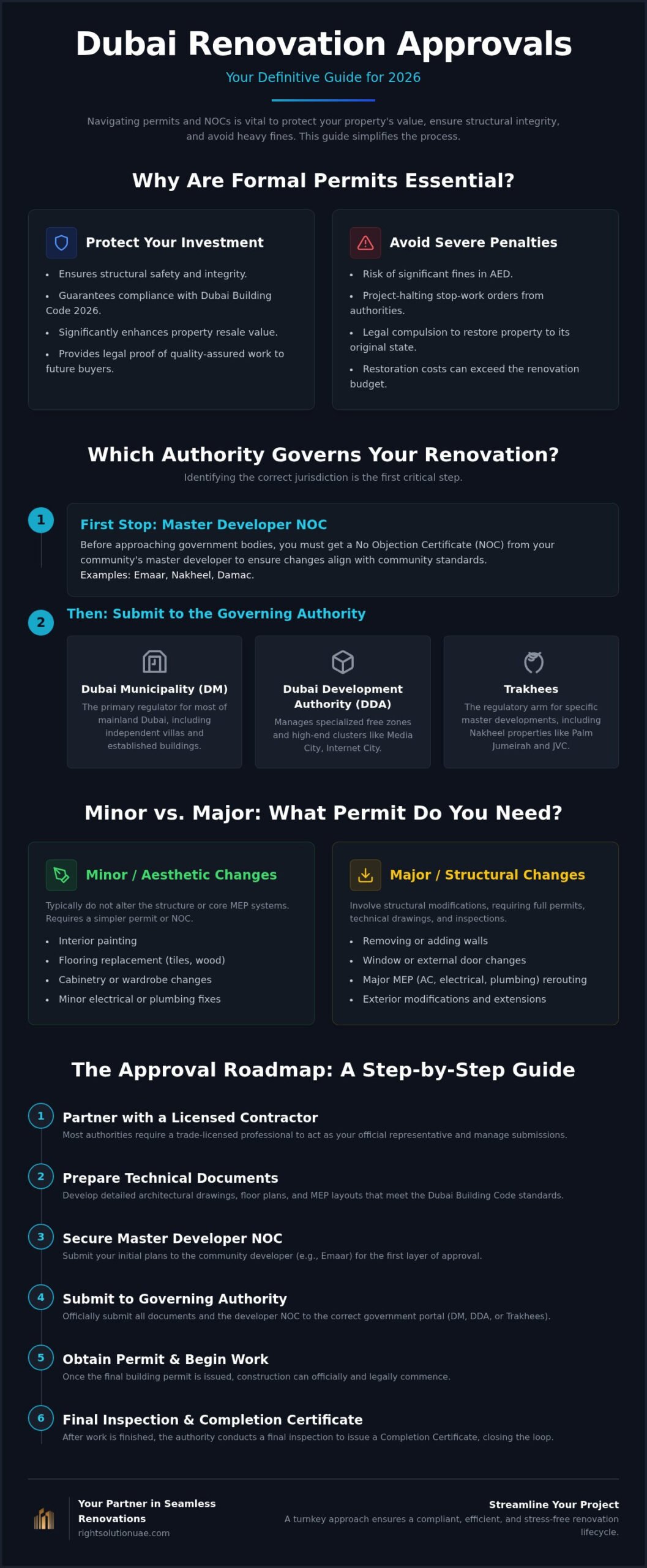
The Step-by-Step Roadmap to Securing Approvals
Transforming a design concept into a legal construction site requires a methodical progression through several regulatory gates. In Dubai, the process is highly digitized and structured to ensure that every modification aligns with the city’s safety and aesthetic standards. A common pitfall for many property owners is rushing into the procurement of materials before the Pre-Approval phase is finalized. This often leads to costly design rework if an authority requests changes to your structural or MEP layouts. By following a disciplined roadmap, you ensure that your investment is protected from the very first day.
Securing authority approvals for renovation Dubai is a journey that moves from the master developer to the specific government regulators. Each stage has its own set of requirements and technical benchmarks. At Right Solution Contracting LLC, we manage this entire lifecycle, allowing you to experience the creative process without the administrative burden. If you’re ready to begin your journey, our team can handle the full renovation process from initial drawing to final certificate.
Phase 1: Design and Documentation
Your project begins with the creation of detailed technical drawings. These must clearly contrast the As-Built state, which is the property’s current legal condition, with the Proposed changes. Once these drawings are ready, the first external step is obtaining a No Objection Certificate (NOC) from your Master Developer, such as Emaar or Nakheel. This phase also involves preparing specialized MEP and Fire & Safety drawings. These documents are essential for ensuring that your new layout doesn’t interfere with the building’s core life-safety systems or utility infrastructure.
Phase 2: Submission and Execution
With the developer’s NOC in hand, the next step is the formal submission through the Dubai Building Permit System. This stage requires the payment of specific permit fees and security deposits in AED. Once the permit is issued, it’s a legal requirement in Dubai to display the document prominently at the site entrance. During the construction phase, authorities will conduct scheduled inspections. These visits verify that the work on-site matches the approved plans and that all safety protocols are being strictly followed.
Phase 3: Completion and Deposit Refund
The final phase is as critical as the first. Once the physical work is finished, you must obtain a Completion Certificate (CC) or a Fit-out Completion Certificate. This document proves that the renovation was executed according to the approved standards. Achieving this involves final inspections by DEWA and Dubai Civil Defence to ensure all utility connections and fire systems are operational. Only after the CC is issued can you apply to have your initial security deposit refunded by the developer, marking the formal and successful conclusion of your project.
Streamlining Your Dubai Renovation with Right Solution Contracting
Choosing a turnkey partner is the most effective way to transform the administrative burden of a renovation into a structured, predictable process. At Right Solution Contracting LLC, we recognize that your primary focus should be the aesthetic and functional evolution of your space, not the technicalities of building permits. By integrating our in-house MEP and structural engineering teams, we eliminate the friction often found when coordinating between multiple external consultants. This unified approach ensures that every drawing is technically accurate from the initial submission, significantly reducing the likelihood of authority rejections.
Our established presence in the market allows us to manage authority approvals for renovation Dubai with a level of precision that only decades of experience can provide. We don’t just submit documents; we leverage a deep understanding of the specific expectations held by officers at DM, DDA, and Trakhees. This proactive management style prevents the project delays that frequently plague unauthorized or poorly managed works. When you partner with us, you aren’t just hiring a contractor; you’re engaging a curator who values the legal and structural integrity of your environment as much as its final beauty.
Expertise Since 2005: Navigating the Evolution of Dubai Permits
Operating in Dubai since 2005 has given us a front-row seat to the city’s regulatory maturation. We’ve successfully adapted to every technological shift, from physical document submissions to the sophisticated digital portals of 2026. This historical perspective is invaluable when managing complex projects in high-end communities like Palm Jumeirah or Emirates Hills, where standards are exceptionally rigorous. Our “Right First Time” philosophy is built on this foundation of experience. We stay ahead of the latest code updates to ensure that your project remains compliant with the most current safety and environmental standards, protecting your investment from the first day of design.
Your Vision, Our Bureaucracy Management
The emotional impact of a physical space shouldn’t be overshadowed by the stress of paperwork. While our technical teams are busy securing the necessary NOCs and permits, you can remain focused on selecting the materials and finishes that will define your home. We provide transparent reporting on every approval status, giving you a clear window into the timeline without requiring you to manage the details. Our role is to act as your authoritative guide, simplifying the complex so that the path to your dream property remains clear and inspiring. If you’re ready to move forward with a partner who handles every technical detail, you can Book a consultation with our approval experts today to begin your transformation.
Securing Your Property’s Future with Expert Guidance
Mastering the landscape of authority approvals for renovation Dubai is ultimately an investment in your property’s longevity and legal standing. By identifying the correct jurisdiction and adhering to the 2026 Building Code, you protect your villa or commercial space from unnecessary friction. We’ve explored how early documentation and a clear roadmap from design to the final completion certificate are essential for a successful transformation. These steps aren’t just administrative hurdles; they’re the foundation of a safe and valuable home.
Right Solution Contracting LLC has been a trusted partner in this journey since 2005. Our in-house MEP and structural teams provide a turnkey approval management service that removes the burden of bureaucracy from your shoulders. We ensure your vision is realized with precision, craftsmanship, and absolute compliance. Start Your Hassle-Free Renovation with Right Solution Contracting LLC and experience the peace of mind that comes with professional expertise. Your dream environment is within reach; let’s build it together with quiet confidence and clarity.
Frequently Asked Questions
How long does it typically take to get renovation approvals in Dubai?
Approval timelines generally range from 5 to 15 business days depending on the complexity and jurisdiction of the property. Minor works permits from Dubai Municipality or Trakhees are often processed faster than major structural building permits. Developer NOCs typically take 3 to 5 working days. A turnkey contractor can streamline this by ensuring all technical drawings are error-free before the initial submission.
Can I start my villa renovation before the permits are issued?
You should never commence physical work on your villa until all mandatory permits are officially issued and displayed at the site. Starting early is considered a violation of the Dubai Building Code and can lead to immediate stop-work orders. Security guards in many gated communities are instructed to deny entry to contractors who cannot present a valid work permit from the relevant authority.
What are the fines for renovating without a permit in Dubai?
Fines for unauthorized renovation work can be substantial, often reaching several thousand AED depending on the severity of the violation. Beyond the financial penalty, authorities may legally require you to restore the property to its original state at your own cost. These penalties are designed to ensure that structural integrity and public safety are never compromised by unverified modifications.
Do I need DEWA approval for a simple kitchen renovation?
DEWA approval is necessary if your kitchen renovation involves relocating water lines or increasing the electrical load for new appliances. If you’re simply replacing cabinets or tiles without touching the plumbing or electrical infrastructure, you might only need a developer NOC. However, it’s safer to have a licensed professional review your MEP plans to confirm compliance with current utility standards.
What is the difference between a Developer NOC and a Municipality Permit?
A Developer NOC is a consent letter from the master developer confirming the project meets community aesthetic standards. A Municipality Permit is the legal authorization from the government regulator to perform construction. Securing authority approvals for renovation Dubai requires both; the developer NOC is usually a mandatory prerequisite before you can apply for the formal government building permit.
How much are the typical authority fees for a residential fit-out?
Authority fees vary significantly based on the project’s scope and the specific jurisdiction involved. Homeowners should budget for permit application fees, knowledge fees, and refundable security deposits paid to the master developer. These administrative costs are paid directly through the government portals and developer systems as part of the official submission process rather than being part of the contractor’s service fee.
Can Right Solution Contracting handle approvals for commercial offices in DIFC?
Yes, we provide comprehensive management for authority approvals for renovation Dubai across all major jurisdictions, including specialized zones like DIFC. Commercial projects often require additional coordination with entities like Dubai Civil Defence and specific building management teams. Our team manages these complex interactions to ensure your office fit-out remains compliant with the specific registrar requirements and remains on schedule.
What documents do I need to provide as a homeowner for the approval process?
You typically need to provide a copy of your Title Deed or Oqood, a valid passport, and your Emirates ID. If the property is currently rented, a No Objection Certificate from the owner is also required to proceed. These documents allow your registered contractor to initiate the application process through the relevant digital portals and act as your authorized representative throughout the project.