
Imagine investing months into a bespoke villa renovation only to have your air conditioning fail during a 45°C Dubai afternoon because of an overlooked electrical load issue. It’s a frustrating reality for many homeowners who prioritize aesthetic finishes while neglecting the invisible systems that truly define a home’s longevity. You likely recognize that common MEP problems in Dubai villas, from faulty wiring to outdated plumbing, can quickly transform a visionary project into a series of unforeseen costs and regulatory delays.
To safeguard your investment, you must approach your renovation with technical precision and a clear understanding of local requirements. This article identifies seven essential mechanical, electrical, and plumbing assessments designed to protect your budget and ensure peak performance in the UAE’s demanding climate. We will preview the critical steps for achieving a technically sound home, including navigating the latest DEWA standards and ensuring compliance with the Al Sa’fat Green Building Code. By addressing these foundational elements early, you can enjoy a seamless integration of modern technology and a living space that performs as beautifully as it looks.
Key Takeaways
- Identify and mitigate common MEP problems in Dubai villas before they impact your renovation budget or project timeline.
- Master the requirements for electrical load evaluations to ensure your property aligns with the latest DEWA technical standards and modern power demands.
- Discover how specialized HVAC and plumbing assessments future-proof your home against the unique environmental challenges of the UAE.
- Learn the art of coordinating technical infrastructure with bespoke interior fit-outs to achieve a seamless and sophisticated final aesthetic.
- Understand why a turnkey partner with established local authority expertise is essential for navigating Dubai’s evolving regulatory landscape.
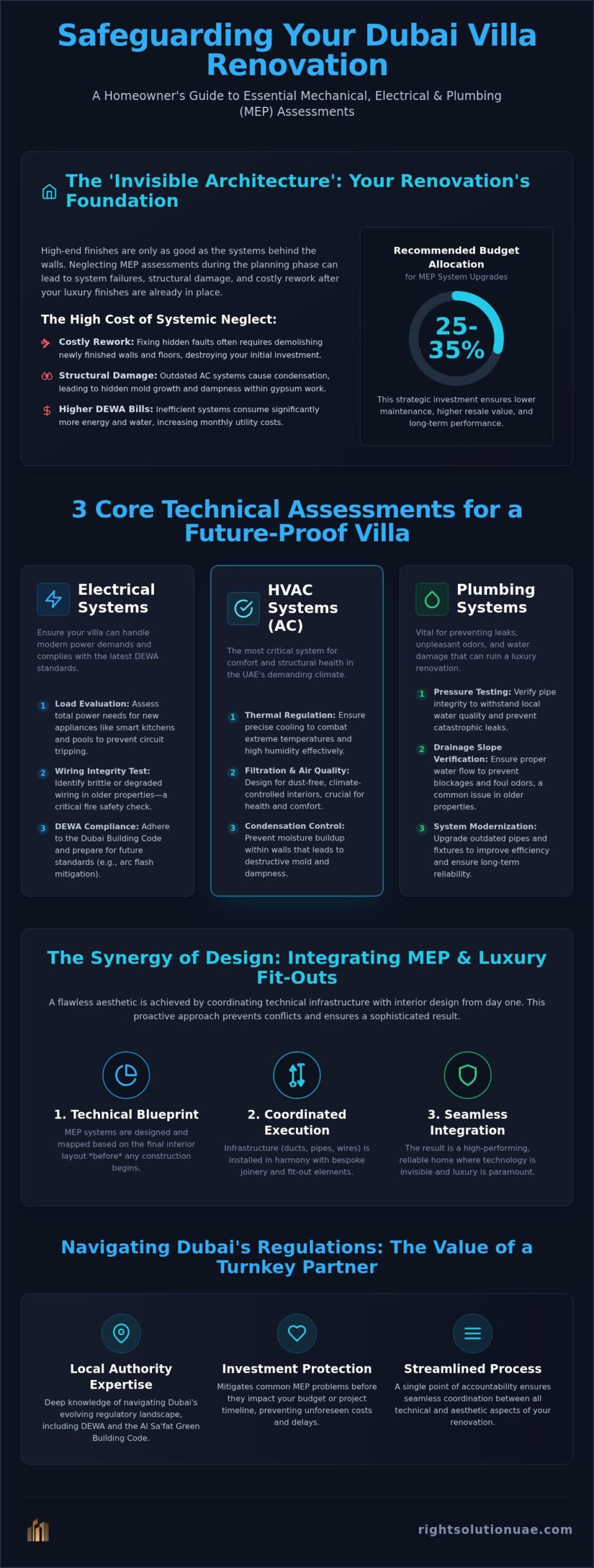
Understanding the ‘Invisible Architecture’: Why MEP is Critical for Dubai Villas
A villa’s aesthetic beauty is only as sustainable as the systems hidden behind its walls. While high-end finishes define the visual experience, the technical infrastructure serves as the central nervous system of the entire property. In the unique environment of the United Arab Emirates, these systems are not mere utilities; they’re the primary defense against extreme ambient temperatures and relentless humidity. Homeowners who overlook Mechanical, electrical, and plumbing (MEP) assessments during the early stages of a project often fall into the “rework trap.” This happens when luxury finishes are applied, only for a faulty circuit or an undersized AC duct to necessitate costly demolition mid-project. It’s a preventable setback that disrupts both timelines and budgets.
The Functional Core of a UAE Home
In Dubai, MEP systems must operate at a higher standard than in more temperate climates. Mechanical systems, specifically HVAC, are responsible for precise thermal regulation and sophisticated filtration to ensure dust-free, climate-controlled interiors. Electrical work goes beyond basic wiring. It involves managing the total connected load for modern appliances and integrating high-speed data cabling for seamless smart home functionality. Plumbing systems require rigorous pressure testing and drainage slope verification. These steps are vital to withstand local water quality and prevent the unpleasant odors that often plague older properties in established communities.
The High Cost of Systemic Neglect
Financial planning for a premium renovation requires a strategic shift in perspective. Many industry professionals recommend allocating between 25% and 35% of the total renovation budget specifically to MEP upgrades. This investment pays dividends through significantly lower monthly DEWA utility bills and improved energy efficiency. Beyond the immediate costs, addressing common MEP problems in Dubai villas prevents long-term structural damage. For instance, outdated cooling systems often cause excessive condensation. This leads to silent mold growth and structural dampness within the gypsum work and wall finishes. By prioritizing these technical foundations, you don’t just build a home; you secure a high-performing asset with a higher resale value and lower maintenance requirements. Proper planning ensures that your renovation remains a source of pride rather than a series of technical headaches.
Electrical Load Assessments and Navigating DEWA Compliance Standards
Upgrading a villa’s interior design often necessitates a parallel evolution of its electrical capacity. Many homeowners find that adding luxury amenities, such as temperature-controlled swimming pools or high-performance smart kitchens, quickly exceeds the property’s original power allocation. In established communities like Jumeirah, circuit tripping remains one of the most common MEP problems in Dubai villas, as older electrical systems struggle to meet the demands of modern appliances. Ensuring your home remains safe and functional requires a rigorous assessment of the total connected load before any physical work begins. This assessment determines whether your existing infrastructure can support your vision or if a formal load upgrade is required.
Evaluating Existing Wiring and Circuitry
Testing insulation resistance is a critical first step in any renovation project. This diagnostic identifies brittle or degraded wiring, which is among the more hazardous common MEP problems in Dubai villas, particularly in structures built over a decade ago. If your renovation involves shifting interior walls or changing room layouts, a full rewiring is often the most prudent path. This allows for the decommissioning of redundant circuits and the implementation of a streamlined electrical plan that adheres to the latest Dubai Building Code. Modern safety standards, including arc flash detection and mitigation systems mandated for new switchgear in 2026, should be integrated during this phase to ensure long-term property protection.
The DEWA Load Upgrade and M-Form Process
Navigating DEWA compliance is a structured process that demands technical expertise and precise documentation. If your proposed renovation exceeds the villa’s original allocated power capacity, your contractor must submit an M-Form to obtain a No Objection Certificate (NOC). This application requires a professional Load Schedule, which must be prepared and stamped by a DED-licensed firm. Under Law No. (3) of 2026, all buildings must now hold a Quality and Safety Certificate, making these approvals essential for legal and structural integrity.
Typical timeline expectations for DEWA inspections vary across residential zones, but early coordination is vital to avoid project delays. Upgrading your Distribution Boards (DBs) to meet 2026 smart-metering standards not only ensures compliance but also allows for better energy management. Partnering with a specialist in MEP work ensures these regulatory hurdles are managed efficiently, allowing you to focus on the creative aspects of your villa transformation. Proper planning at this stage prevents the frustration of power failures and ensures your home can handle the technical demands of a contemporary lifestyle.
HVAC and Plumbing: Future-Proofing Your Villa Against the UAE Climate
In a region where summer temperatures routinely exceed 45°C, the Heating, Ventilation, and Air Conditioning (HVAC) system is the most critical mechanical component of any villa. It’s the difference between a sanctuary and an uninhabitable space. Similarly, plumbing systems must be meticulously inspected to prevent the lingering odors and silent leaks that represent some of the most common MEP problems in Dubai villas. Future-proofing these systems requires more than a simple repair; it demands a strategic assessment of how your home handles water and air in a high-demand environment. Neglecting these foundations during a renovation often leads to structural dampness that can ruin expensive interior finishes within a single season.
Optimising Cooling Loads for Extreme Summers
A frequent mistake during renovations is keeping the original AC units while significantly changing the interior layout. If you’ve removed walls to create an open-plan living area or installed larger floor-to-ceiling windows, your cooling load has fundamentally changed. A professional recalculation is essential to ensure your HVAC system isn’t overworking, which leads to premature failure and higher DEWA bills. Beyond capacity, hygiene is paramount. The dusty nature of construction means that professional duct cleaning and sanitisation are mandatory before you move back in. Integrating smart thermostat systems like Nest or KNX provides the automated climate control needed to manage energy consumption efficiently across different zones of the property, helping you stay within lower DEWA tariff slabs.
Advanced Water Management and Drainage Solutions
Plumbing inspections during a renovation must go beyond looking for visible leaks. Pressure testing the entire supply line ensures the system can handle the high-pressure pumps required for modern luxury rain showers. For older villas in communities like Arabian Ranches or Jumeirah, CCTV drain inspections are an invaluable tool. These cameras identify hidden blockages or root intrusions in the foundations before they cause a backup. We also pay close attention to the routing of condensation drains. If these aren’t correctly directed to the main drainage or a soakaway, the resulting moisture causes paint peeling and structural dampness.
Choosing between central and individual water heater systems is another vital decision for the modern homeowner. Central systems are often more energy-efficient and free up valuable cupboard space within the villa, though they require precise circulation pump planning to ensure instant hot water at every tap. This approach aligns with the mandatory Al Sa’fat Silver rating requirements for water conservation, which mandate efficient fixtures and dual-flush systems. Finally, your external MEP plan should seamlessly integrate irrigation systems with your new landscaping to ensure water efficiency and plant health throughout the year without wasting precious resources.
The Synergy of Design: Integrating MEP with Luxury Interior Fit-Outs
True luxury in a villa renovation is defined by the seamless interaction between sophisticated design and flawless technical performance. When these elements are siloed, homeowners often encounter common MEP problems in Dubai villas, such as unsightly exposed conduits or air conditioning vents that disrupt the clean lines of a decorative ceiling. Achieving a refined finish requires a meticulous coordination process where the technical infrastructure is treated as an integral part of the architectural vision rather than an afterthought. This integration ensures that every functional element serves the aesthetic goals of the space.
A successful integration follows a structured progression to maintain design integrity:
- Step 1: Coordinate AC linear diffuser placement with decorative gypsum work. This ensures that cooling vents are discreetly tucked into ceiling recesses or shadow gaps for a minimalist appearance.
- Step 2: Map electrical outlets to align perfectly with bespoke furniture and custom wardrobe layouts. This prevents the need for unsightly extension cables or the obstruction of power points by heavy joinery.
- Step 3: Plan “hidden” MEP access panels within custom cabinetry. These allow for essential future maintenance without requiring the demolition of expensive wall finishes or gypsum structures.
- Step 4: Integrate smart home sensors and control panels into the aesthetic fabric of each room. Recessed sensors and flush-mounted interfaces maintain the visual flow of the interior architecture.
Concealing Systems within Bespoke Joinery
One of the primary advantages of working with a partner that provides in-house carpentry is the ability to elegantly conceal technical components. At Right Solution Contracting LLC, our joinery division works alongside our MEP experts to design custom media units and walk-in wardrobes that house bulky AC units or electrical sub-panels. This collaborative approach eliminates the communication errors that often occur between separate contractors. Lighting design also plays a pivotal role. We plan dedicated circuits for task, ambient, and accent lighting, ensuring that the wiring for delicate LED strips in shelving or heavy chandeliers is fully integrated into the initial structural plan.
Smart Villa Infrastructure and Future-Proofing
Modern Dubai living demands a robust digital foundation. We prioritize the installation of high-grade data cabling, such as Cat6 or Cat7, to ensure reliable Wi-Fi coverage across multi-story properties. This physical infrastructure supports a unified home automation plan that centralizes lighting, curtains, and security systems. Looking forward, your electrical plan must also account for the shift toward sustainable transport. We ensure that garage provisions include the necessary power capacity and cabling for future EV charging stations. By addressing these needs now, you avoid the disruptive common MEP problems in Dubai villas that arise when adding technology to a finished space. For a project that perfectly balances technical excellence with visionary design, explore our comprehensive interior and exterior fit-out services.
Selecting a Turnkey MEP Partner: The Right Solution for Dubai Homeowners
The final and most critical safeguard for any renovation is the selection of a partner who understands the intricate relationship between structure and system. While many homeowners consider managing separate trades to save on initial costs, this approach often invites the very common MEP problems in Dubai villas that lead to budget overruns. A turnkey contractor who manages design, fit-out, and MEP under one roof eliminates communication gaps and ensures that technical requirements are baked into the architectural vision from day one. This unified accountability is essential for maintaining the high standards expected in premium communities like Arabian Ranches or Palm Jumeirah.
Verifying a contractor’s DED licensing and community-specific experience is a non-negotiable step. In Dubai, the technical infrastructure of villas varies significantly between older developments and newer districts. A partner with a proven track record understands these nuances, from the specific drainage challenges in coastal areas to the electrical load limitations in established suburban clusters. Choosing a firm with in-house teams rather than a reliance on sub-contractors provides you with direct control over quality, safety, and the project timeline.
Regulatory Approvals and Compliance Management
Navigating the approval processes of the Dubai Municipality (DM) or Trakhees requires more than just administrative effort; it requires technical precision. Professional MEP drawings are a mandatory prerequisite for obtaining structural No Objection Certificates (NOCs). These documents serve as the technical blueprint that proves your renovation adheres to the latest safety standards, including the mandatory Al Sa’fat Silver energy reduction targets. Without these approved plans, you risk significant fines and delays. The process concludes with final inspections, where authorities verify that the installation is fully compliant with Law No. (3) of 2026. This certification is your guarantee that the home is legally sound and safe for your family to occupy.
The Advantage of a 20-Year UAE Legacy
Right Solution Contracting LLC has operated within the Dubai renovation landscape since 2005. This 20-year legacy provides a level of insight that newer firms simply cannot replicate. Our dedicated in-house MEP division consists of engineers who specialize exclusively in the unique requirements of luxury villas. We don’t just fix systems; we curate environments that perform efficiently under the UAE’s environmental pressures.
Our commitment to transparent project management means you receive detailed MEP reports and load schedules before a single brick is moved. This foresight prevents the common MEP problems in Dubai villas that arise from guesswork or outdated information. We act as your visionary partner, simplifying complex technical hurdles so you can focus on the aesthetic transformation of your home. To ensure your property is ready for its next chapter, Book a comprehensive MEP assessment with Right Solution today.
Securing the Technical Integrity of Your Future Home
A successful villa renovation is a sophisticated balance of visionary design and technical resilience. By prioritizing electrical load assessments and future-proofing your HVAC systems, you ensure that your home remains a sanctuary even during the peak of the UAE summer. Integrating these mechanical and plumbing systems with your interior fit-out from the start prevents the common MEP problems in Dubai villas that often derail high-end projects. This methodical approach protects your investment and ensures compliance with evolving local regulations.
Right Solution Contracting LLC has been serving Dubai since 2005, offering the reliability of in-house MEP and joinery teams who understand the nuances of luxury properties. Our expert management of DEWA and Dubai Municipality approvals simplifies the most complex technical hurdles, allowing you to focus on the creative journey of transformation. It’s about more than just construction; it’s about curating a high-performing environment that lasts.
Schedule Your Expert MEP Villa Inspection with Right Solution
Your renovation deserves a foundation that is as enduring as its aesthetic beauty. We look forward to helping you build a home that performs with excellence for years to come.
Frequently Asked Questions
Do I really need a load upgrade from DEWA for my villa renovation?
You only need a DEWA load upgrade if your renovation increases the property’s total power consumption beyond its original allocation. This is common when adding high-demand features like heated pools, electric vehicle chargers, or professional-grade kitchen appliances. A licensed contractor must evaluate your current load schedule and submit an M-Form application to DEWA to ensure your electrical infrastructure remains safe and compliant.
How long does a typical MEP inspection take for a large 5-bedroom villa?
A thorough MEP inspection for a 5-bedroom villa typically requires one to two business days to complete accurately. Our engineers perform a series of diagnostic tests, including insulation resistance testing for wiring and pressure testing for plumbing lines. This detailed audit identifies potential risks before construction begins, allowing us to provide a precise technical report that informs your renovation strategy.
Can I change my AC system without obtaining a new NOC?
Any significant change to your HVAC system, such as replacing outdoor units or modifying duct layouts, requires a No Objection Certificate (NOC). This approval ensures that the new system meets the latest energy efficiency standards, such as the Al Sa’fat Silver rating. Proceeding without this permit can lead to complications during final municipality inspections or when you attempt to sell the property.
What are the most common MEP issues found in older Dubai villas?
The most common MEP problems in Dubai villas involve degraded electrical insulation and inefficient cooling systems in properties over ten years old. You’ll often find that older plumbing lines have accumulated mineral deposits that restrict water pressure and flow. Addressing these systemic issues during the renovation phase prevents the need for invasive repairs once your luxury finishes are in place.
How much of my budget should MEP work typically account for in a full renovation?
Allocating approximately 25% to 35% of your total renovation budget to MEP systems is a standard industry benchmark for high-quality projects. While it’s tempting to focus on visible finishes, these invisible systems determine the long-term performance and comfort of your home. Investing in robust technical infrastructure reduces future maintenance costs and significantly lowers your monthly DEWA utility expenses.
Is it possible to install a smart home system in an older villa structure?
You can certainly integrate smart technology into an older villa by upgrading the foundational wiring and installing high-speed data cabling. We often implement hybrid solutions that combine hardwired infrastructure for security and lighting with wireless protocols for peripheral devices. This approach ensures a reliable smart home experience without compromising the architectural integrity of an established property.
Why is my AC making a whistling noise following a recent renovation?
A whistling noise from your AC usually indicates an imbalance in air pressure or a leak in the ductwork following a renovation. This often happens when new gypsum ceilings restrict the return air path or if diffusers aren’t correctly calibrated for the room’s volume. A professional technician can identify the specific source of the noise and adjust the airflow to restore quiet, efficient operation.
Do I need to replace my plumbing pipes if I am only renovating the kitchen?
It’s highly advisable to replace plumbing feeder lines when renovating a kitchen, even if the primary goal is aesthetic. Older pipes may have hidden corrosion or weak joints that are prone to failure under the pressure of modern fixtures. Replacing these lines while the walls are open protects your investment in new cabinetry and prevents the catastrophic damage caused by a hidden water leak.