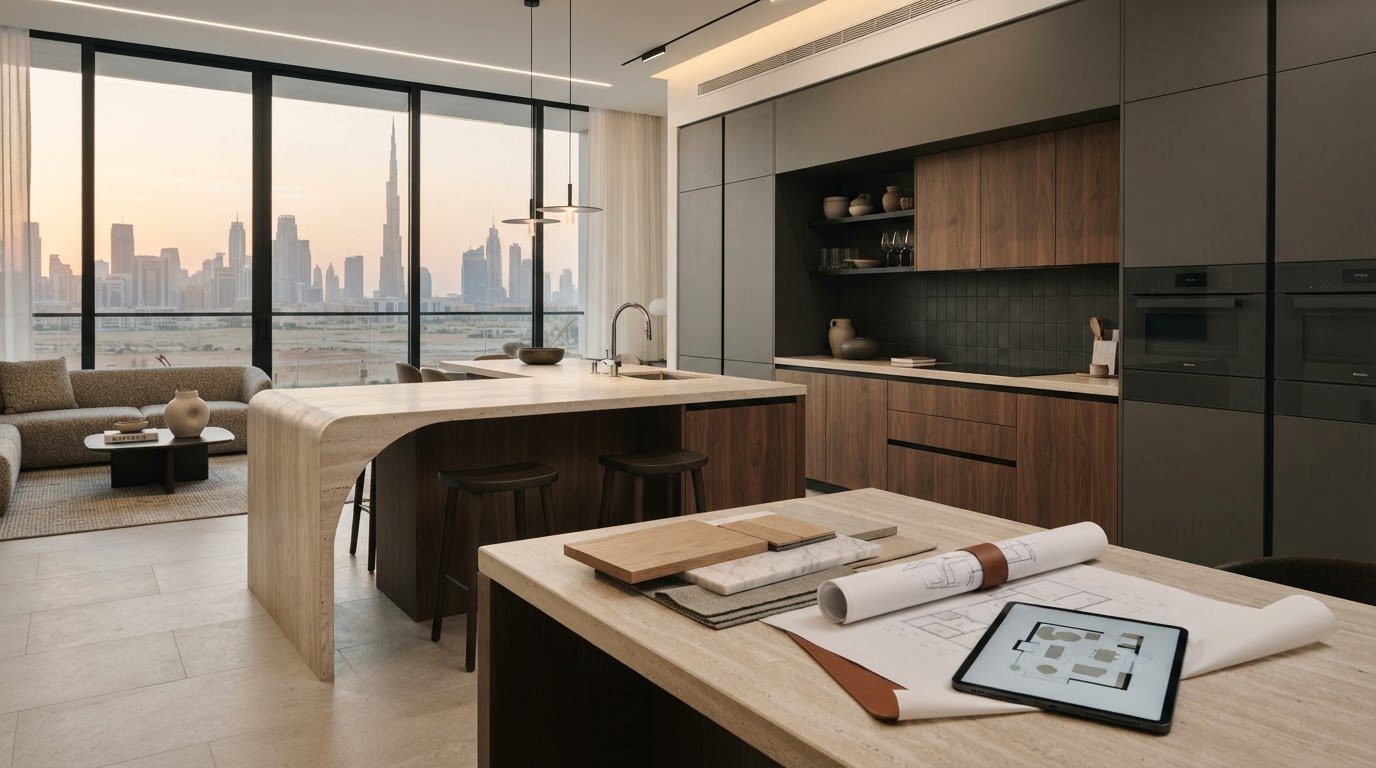
What if Arabic character could make a contemporary room feel calmer and more functional, rather than more ornate? Modern Arabic interior design can do this by drawing on heritage for ideas about proportion, privacy, light and craftsmanship, not just pattern. If you’re concerned that arches, screens or geometric details might overwhelm your space, use them with intention and let everyday needs guide the design.
This guide explains how to bring Arabic design principles into a cohesive home or commercial interior in Dubai. You’ll see how to choose between subtle references, such as a warm palette or a carefully placed screen, and more expressive features, including geometric detailing or a contemporary majlis. We’ll also explore how layout, materials, lighting, furniture and custom carpentry work together. The result is a practical approach to creating a space that feels welcoming, comfortable and suited to modern life.
Key Takeaways
- Modern Arabic interior design draws on heritage through proportion, privacy, light and selected details, rather than relying on a single defining motif.
- Plan sightlines, daylight, layered lighting and materials around the room’s purpose and the needs of daily life in Dubai.
- Compare subtle, balanced and statement-led approaches to find an expression that suits your property without overwhelming it.
- Build a clear plan from lifestyle brief to concept, finishes and coordination, and assess technical requirements for the specific project.
- Coordinated fit-out, customized furniture, carpentry, gypsum work and MEP can carry one design concept through to execution.
What defines modern Arabic interior design in a contemporary space?
Modern Arabic interior design pairs contemporary function with selected references to Arabic design heritage. Rather than reproducing a traditional interior, it can use ideas about proportion, privacy, light, geometry, materials and craft to shape how a room looks and works. The result may be understated or expressive, but each detail should have a purpose.
There’s no single Arabic design vocabulary that every home must follow. Regional traditions, personal histories and architectural settings are varied, so an arch, geometric pattern or calligraphic detail isn’t a universal requirement. In a Dubai home, the design can respond to the property’s layout, residents’ privacy preferences and the way rooms are used throughout the day. Cultural references feel more considered when they influence the room’s structure and atmosphere, rather than appearing only as added ornaments.
Heritage and contemporary function can coexist when cultural references shape how a space feels and works, not simply what decor it displays.
Which design principles create an Arabic character?
Geometry is one possible reference, not a checklist item. It might appear as a restrained repeat in a screen or a single surface detail, balanced by simpler forms elsewhere. Layered boundaries can define zones and manage sightlines while filtering daylight. The Mashrabiya, a traditional lattice feature associated with privacy and filtered light, offers one reference for this approach. Materials and craftsmanship should suit the room’s use: tactile finishes can add warmth to a welcoming area, while carefully resolved joinery can keep everyday storage orderly.
How does modern Arabic design differ from a traditional look?
A traditional composition may give ornament, decorative surfaces and repeated motifs greater prominence. A contemporary interpretation often edits these details, pairing clean layouts and current furniture forms with one or two heritage-inspired features. For example, a streamlined seating arrangement might sit alongside a patterned screen, or a restrained palette might give a crafted timber detail greater presence. The balance depends on the client’s preferences, the property and daily routines, so the references should feel natural to the people using the space.
This distinction is less about choosing between old and new than deciding what deserves emphasis. Start by considering what the room needs to do, then select references that support that purpose. A screen may create separation; a geometric accent can provide visual rhythm; considered materials can add depth without filling every surface with decoration. A coherent composition keeps cultural character visible while making circulation, furniture and practical use central to the design.
How do light, privacy, materials, and geometry shape the design?
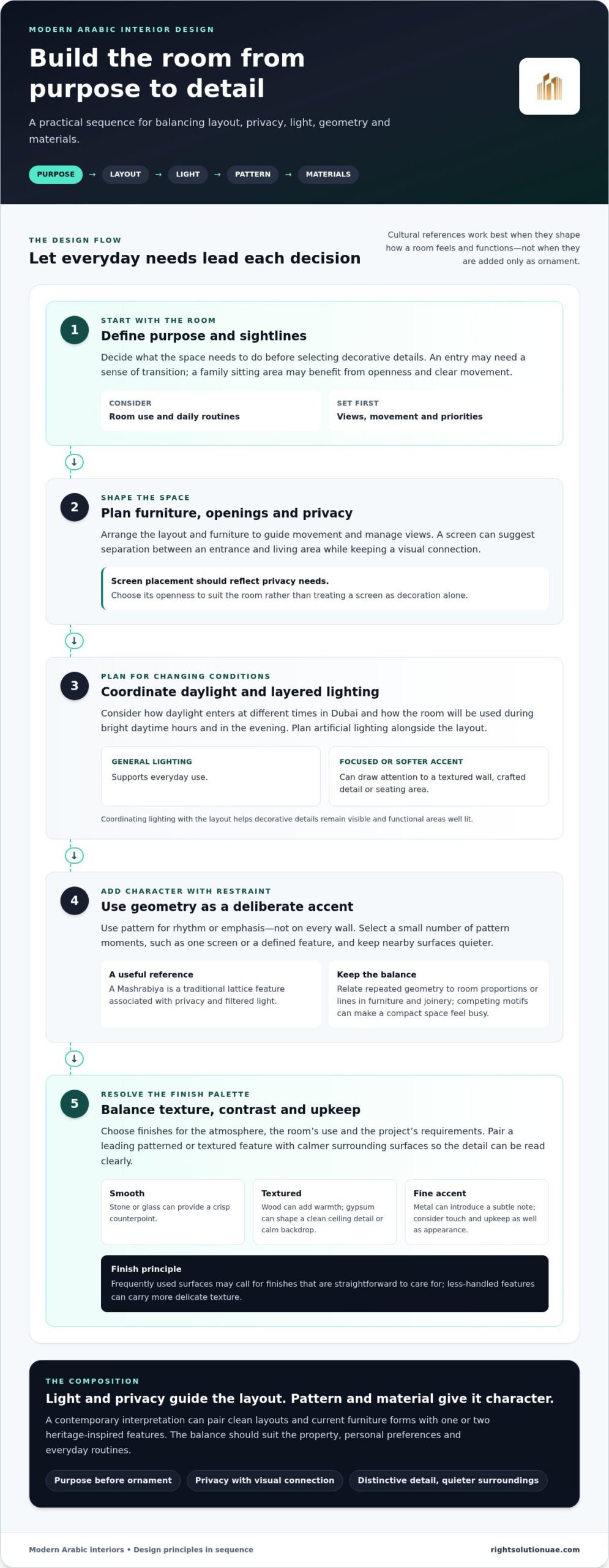
In modern Arabic interior design, these elements work together rather than compete for attention. Start with the room’s purpose and sightlines: an entry may need a sense of transition, while a family sitting area may benefit from openness and clear movement. Plan furniture, openings and screens to shape views before choosing decorative details. In Dubai, consider how daylight enters at different times and how the room will be used during bright daytime hours and in the evening.
Lighting should support both atmosphere and activity. Daylight can define a room’s character, while layered artificial lighting helps different areas feel comfortable after dark. General lighting supports everyday use; focused or softer accent lighting can draw attention to a textured wall, crafted detail or seating area. Planning lighting alongside the layout helps prevent decorative features from being difficult to see or functional areas from being poorly lit.
A cohesive room lets light and privacy guide the layout, then uses pattern and material to give that structure character.
How can geometric patterns and screens be used with restraint?
Use geometric pattern for rhythm or emphasis, not as a treatment on every wall. A screen can suggest separation between an entrance and a living area while retaining a visual connection. Its placement and openness should reflect the room’s privacy needs. Choose a small number of pattern moments, such as one screen or a defined feature, and keep nearby surfaces quieter so the eye has room to rest.
Before settling on a pattern, consider what it will sit beside. Repeating geometry can relate to a room’s proportions or echo lines in furniture and joinery, but several competing motifs may make a compact space feel busy. A restrained approach gives a distinctive detail more presence without making it the only thing the room expresses.
Which materials and finishes support a balanced contemporary interior?
Balance smooth and textured finishes according to the atmosphere and use of each space. Smooth stone or glass can create a crisp counterpoint to textured wood, while metal can introduce a fine accent. Gypsum can shape a clean ceiling detail or provide a calm backdrop. Select each finish for its application and the project’s requirements.
Think about touch and upkeep as well as appearance. A frequently used surface may call for a finish that’s straightforward to care for, while a less-handled feature can carry more delicate texture. The palette can also help regulate visual weight: let a patterned screen or textured surface lead, then pair it with calmer surrounding finishes. Contrast makes detail easier to read and keeps the composition from feeling crowded.
For example, a living area might combine a composed wall finish with timber detailing and a single geometric focal point. A more functional zone may rely on easy-to-maintain surfaces and use pattern sparingly. Choose finishes to suit the property, its occupants and the way each room is used. Coordinating them with joinery and fit-out decisions helps the design read as one considered interior. See how interior fit-out planning can bring these choices together.
Which modern Arabic design direction suits your space?
Choose the level of expression by considering how the room is used, how much visual detail feels comfortable and what the property can support. The three approaches below are practical comparison points, not fixed historical categories or named client styles. They can also be combined across a property, with quieter rooms and more expressive shared areas.
| Approach | Ornament level | Visual focus | Flexibility | Suitable context |
|---|---|---|---|---|
| Subtle references | Low | A crafted finish, restrained pattern or repeated detail | High; furnishings can change without redefining the room | A calm apartment living area, bedroom or contemporary office |
| Balanced expression | Moderate | One or two coordinated features, such as a screen and complementary joinery | Moderate; the design has a clear character while allowing practical updates | A villa family room, reception area or hospitality-style lounge |
| Statement-led design | High but focused | A prominent screen, ceiling detail or customized furniture piece | More defined; the focal feature shapes the room’s overall identity | A generous villa majlis, a hospitality-style entrance or a client-facing space |
Design intensity should follow the room’s purpose and the client’s preference, not a preset idea of what an Arabic interior must look like. Property type matters, but it doesn’t dictate the result. An apartment can carry a distinctive focal detail if circulation stays clear, while a villa can feel composed and restrained. In an office, consider how the chosen expression supports the atmosphere without distracting from work. For a hospitality-style setting, a stronger arrival moment may suit the experience, while adjacent areas remain visually quieter.
When does a subtle Arabic influence work best?
A subtle approach suits spaces where visual calm, adaptable furnishings and a lasting composition are priorities. Keep the base contemporary, then introduce a crafted timber detail, a restrained geometric reference or a material contrast. Repeating a detail in a considered way, perhaps in joinery and one nearby accent, can create continuity without covering every surface. Furniture and everyday objects can then remain part of the room’s character.
When can a stronger Arabic design statement feel cohesive?
A more expressive direction works when one focal feature can anchor the room without obstructing movement or competing with its purpose. A screen might define a seating zone; a gypsum ceiling detail or customized furniture piece could establish a distinct centre of attention. Keep surrounding finishes simpler and preserve clear routes through the space. Scale and placement should respond to the room’s dimensions, sightlines and furniture layout.
Use the comparison as a starting point, then judge each choice in the context of the whole property. A feature that feels proportionate in a spacious villa may dominate a smaller apartment. Mapping the focal point, circulation and supporting finishes together helps create a design that feels intentional rather than assembled from unrelated references.
How should you plan a modern Arabic interior before fit-out begins?
A clear plan turns inspiration into decisions that can be coordinated across the room. For modern Arabic interior design in Dubai, begin with the occupants and the property, then develop the visual concept alongside practical requirements. Consider the home’s orientation, daylight, privacy needs and daily routines before deciding where patterned details, screens or custom elements belong.
- Write the lifestyle brief. Record who uses each room, what they do there, what needs to be stored and the atmosphere they want. Separate essential functions from optional decorative ideas.
- Set the design concept. Gather visual references, then identify the specific qualities that matter, such as a geometric detail, crafted joinery or filtered separation. Agree on how prominently each should feature.
- Coordinate the materials. Select a controlled palette and compare finish samples together. Place a pattern sample beside proposed flooring, wall finishes and furniture materials to judge its scale and contrast in context.
- Align the design with technical planning. Coordinate furniture dimensions, lighting intentions, finishes and MEP requirements before fit-out begins. Technical recommendations should reflect the specific project.
- Review the plan as a whole. Check room layouts, sightlines, circulation and finish relationships together. Make sure the design still supports the original brief before moving into execution.
What should a design brief include?
Make the brief specific enough to guide decisions. Note who uses each space, daily activities, storage needs and the desired atmosphere. Add visual references, but explain what appeals in each one: perhaps its screen, material contrast or restrained pattern rather than the entire room. Mark functional priorities separately from optional details. This keeps the concept coherent as choices are refined and helps the design reflect the occupants’ actual routines.
How can design and technical coordination stay aligned?
Furniture, lighting, finishes and MEP should be considered as connected parts of the plan. A screen may affect a sightline; a custom cabinet may need to fit a particular wall and storage requirement; lighting intentions should relate to the ceiling and furniture layout. Customized furniture and carpentry can respond to the property’s proportions, while technical planning should account for the specific project rather than assumptions based on an inspiration image.
Room plans clarify the relationship between furniture, movement and focal details. Finish samples help test whether a geometric motif feels appropriately scaled beside quieter surfaces, and whether materials create the intended atmosphere together. Review these items in context, not as isolated selections. This can reveal when a feature needs adjustment before it becomes part of the fit-out.
For a coordinated path from concept planning to execution, see interior and fit-out solutions.
How can Right Solution Contracting LLC bring the design together?
Turning modern Arabic interior design into a finished space requires the design idea and fit-out work to stay aligned. Right Solution Contracting LLC is a Dubai-based design and fit-out company operating in the UAE since 2005, delivering residential and commercial interiors. Its interior fit-out work coordinates the concept across finishes, customized furniture, carpentry, gypsum details and MEP, so each element contributes to one considered direction.
This coordination matters because design decisions affect one another. A feature wall needs to relate to nearby joinery, furniture placement and lighting intentions. A screen or glazed element may shape sightlines and privacy, while its position also needs to work with circulation. Glass and aluminium work can form part of the composition where it suits the project. Each choice should support the room’s use as well as its visual character.
How can custom furniture and craftsmanship express the concept?
Customized furniture can be planned around a room’s proportions, storage needs and daily use rather than treated as a separate decorative layer. A tailored cabinet might align with a wall detail, or seating could be planned alongside the room’s circulation. Carpentry can carry the selected design language through considered profiles, finishes or a restrained geometric reference. No single motif is required; detailing should reflect the client’s preferences and the space.
Across a larger property, continuity comes from repeating selected details with care. A finish or joinery line used in related ways in connected rooms can create cohesion without making every space identical. The design can vary in intensity according to each room’s purpose, while craftsmanship and material choices make transitions feel intentional.
Why coordinate fit-out trades around one design direction?
Interior fit-out brings the visual concept into practical coordination. Furniture dimensions and carpentry details should relate to finishes and gypsum work; MEP requirements should be considered alongside the intended layout and lighting; glass and aluminium elements should fit the design where relevant. Reviewing these relationships together helps keep individual decisions from pulling the overall composition in different directions.
For example, a project might use a crafted furniture detail as a recurring reference, while keeping ceiling treatments and surrounding finishes restrained. This is an illustrative approach, not a prescribed solution. The right design and technical coordination depends on the property, room dimensions and how occupants use the space. Right Solution Contracting LLC brings fit-out execution and related work together around the agreed concept, carrying design intent through planning and completion.
Before starting, define the balance you want between heritage references, contemporary comfort and decorative detail. A clear direction gives each finish, furniture element and technical decision a purpose. Discuss your interior transformation with Right Solution Contracting LLC.
Shape a space that feels distinctly yours
The strongest modern Arabic interior design begins with a clear sense of what you want the space to feel like and how it needs to serve you. Before choosing finishes or decorative details, identify the cultural references that feel meaningful, the level of visual expression you prefer and the routines the design should support. These priorities give the project direction, even as individual choices are refined.
A useful next step is to turn those priorities into a concise brief: note what matters most, what should remain flexible and how you want the finished space to support daily life. With that foundation, design discussions can focus on the character you want to create and how it can be carried into the fit-out. Right Solution Contracting LLC can help develop your project. Plan your interior transformation and take the first step toward a space that feels considered, functional and personal.
Frequently Asked Questions
What is modern Arabic interior design?
Modern Arabic interior design brings contemporary living needs together with selected references to Arabic heritage. Its character can come from the way rooms balance openness and privacy, or from considered geometry, materials and craft. In a Dubai home, this might mean making an entry distinct from the living area, then carrying a subtle reference into cabinetry or lighting rather than applying the same decorative treatment throughout.
Is modern Arabic interior design always ornate?
No. Ornament is optional, and a room can feel connected to Arabic design through its proportions, spatial transitions or crafted details. For a quieter result, keep large surfaces and furniture forms simple, then let one detail provide character, such as a screen or textured finish. This approach can suit a home where residents prefer a calm setting or want their furnishings to remain adaptable.
How can I make an Arabic-inspired interior feel modern?
Begin with contemporary furniture and practical room arrangements, then choose a limited number of heritage-inspired details that relate to them. For example, repeat a geometric line in a cabinet detail and a nearby screen, rather than adding unrelated patterns across multiple surfaces. Review how the elements look together from the main entrance and seating positions. This helps the design feel intentional instead of assembled from separate references.
Can modern Arabic design work in a Dubai apartment?
Yes. The approach can be scaled to an apartment by considering the room’s dimensions, storage needs and sightlines before introducing a focal feature. A compact screen or customized cabinet detail may have more impact than a large architectural gesture. In a rental or a home with changing needs, consider details that work with flexible furniture and don’t rely on altering every surface.
Which colours are used in modern Arabic interiors?
Warm neutrals such as sand, cream and beige can provide a calm base, while terracotta or deeper jewel tones can bring contrast. Wood, stone and muted metallic finishes add tonal variation without relying on strong colour everywhere. Choose shades in relation to the room’s daylight and existing finishes, and view samples together before committing. A small accent can give a neutral interior depth.
How do you avoid making Arabic-inspired design feel themed?
Avoid treating the room like a display of matching cultural references. Instead, decide what each feature contributes, then combine it with furnishings, artwork and materials that reflect the occupants’ preferences. Leave some surfaces visually quiet and vary the details between rooms. Personal objects and contemporary pieces can make the space feel lived in, while a carefully selected reference gives it cultural character.
What should I consider before fitting out a modern Arabic interior?
Before fit-out, document how each room will be used, what needs to be stored and where privacy matters. Review the property’s existing layout, openings and services, then coordinate furniture sizes, lighting positions, finishes and any screen or custom joinery details. Technical requirements depend on the specific space and need project-based assessment. In Dubai, also consider how orientation and daylight affect the rooms you use most.